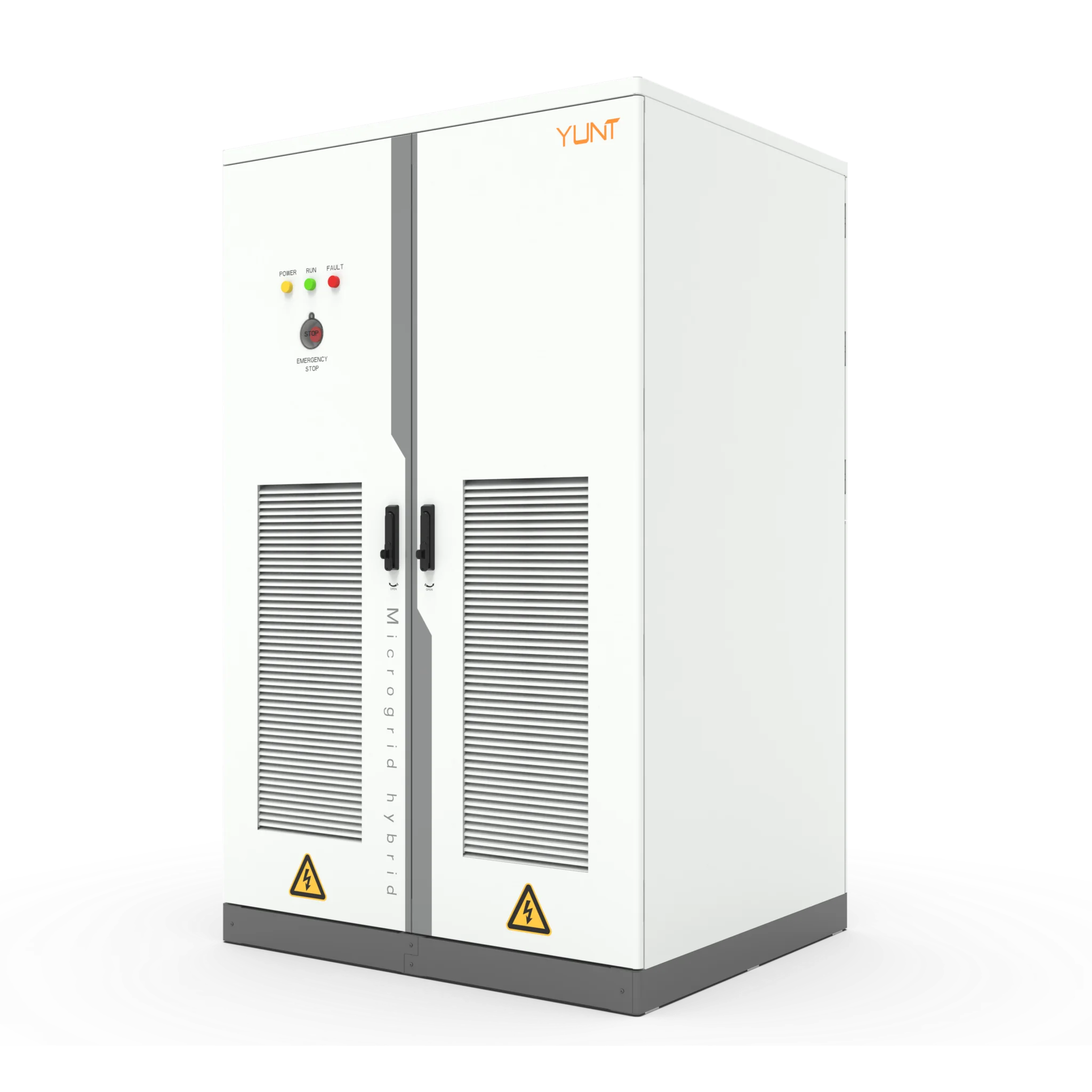
Industrial zones with strict export limits face a different energy-management challenge from ordinary solar installations. Solar generation may exceed local demand during certain hours, yet sending surplus electricity back to the utility can be restricted by grid agreements or local regulations.
A hybrid inverter can coordinate solar production, battery storage, on-site consumption, and grid exchange within one control framework. YUNT develops power-conversion solutions for commercial and industrial energy systems, including equipment designed for both grid-connected and off-grid operation.
Why Zero-Export Requires Active Power Control
Zero-export operation means that electricity generated behind the meter is primarily consumed locally or stored instead of being delivered to the utility network. The concept sounds straightforward, but industrial demand can change rapidly. Production lines may start or stop, while solar output varies with cloud cover and time of day.
A hybrid solar inverter can respond to these changing conditions by directing excess photovoltaic power toward battery charging when on-site demand is insufficient. During periods of stronger consumption, stored energy can be converted for local loads. Meter feedback and control algorithms determine how these energy flows should change.
The difficulty lies in keeping generation and consumption closely matched. Export control is not simply a matter of turning photovoltaic generation down whenever demand falls. Excess solar energy can represent valuable generation that would otherwise be curtailed, so storage and load management can provide another route for using that electricity within the facility.
Managing Solar Surplus Inside Industrial Sites
Industrial facilities often have uneven electricity profiles. Day-shift production may create substantial demand during solar hours, while warehouses, offices, or partially occupied production areas may consume much less power at other times. Such differences influence the amount of solar generation that can be used directly.
An energy storage inverter can help shift surplus solar energy toward later periods. During strong solar production, the battery absorbs available excess power; after generation declines, stored electricity can support local loads. The economic value depends on electricity tariffs, battery operating limits, load patterns, and the site’s energy strategy.
Zero-export control also requires accurate measurement. A system must distinguish between power flowing to facility loads and power approaching the grid connection point. Fast measurement and appropriate control response become increasingly important as the photovoltaic system becomes larger relative to the site’s minimum daytime demand.
Matching Inverter Architecture to Site Conditions
Industrial projects differ considerably in voltage level, solar capacity, battery configuration, and operating priorities. Some sites need only solar self-consumption with battery charging, while others require microgrid functions, backup operation, or integration with additional generation sources.
YUNT’s Neptune-H125T-SA2 is one example of an integrated hybrid platform listed for microgrid applications. Its published specifications include a maximum PV input voltage of 1,000 V, a full-load MPPT voltage range of 340–950 V, maximum PV power of 180 kW, four MPPTs per module, and a 600–1,000 V battery voltage range. The unit also supports 125 kW maximum battery charge/discharge power, with built-in EMS, STS, and ATS functions.
Such specifications matter because the DC and AC sides have to be considered together. PV array sizing, battery voltage, inverter output, and local load demand all affect the usable operating range. System designers also need to account for temperature, altitude, protection requirements, and communication with the site’s energy-management equipment.
Improving Zero-Export Performance Through Coordination
A hybrid inverter becomes more useful when its control strategy reflects the actual behavior of the industrial facility. Battery charging can be prioritized during solar surplus, while discharge can be scheduled around demand peaks or periods of limited renewable generation. These decisions can be linked to production schedules and tariff structures.
The same principle applies to solar curtailment. If the battery has reached its permitted state of charge and factory demand remains low, photovoltaic output may need to be reduced. Good control logic can make this adjustment without treating every surplus period as a system fault.
A hybrid solar inverter can also support different system architectures. YUNT’s hybrid-inverter documentation states support for both PV-storage DC coupling and AC coupling, as well as multiple power sources such as solar and wind. That flexibility can be useful when an industrial zone expands an existing energy system rather than building an entirely new installation.
Building a More Flexible Industrial Energy Strategy
Zero-export projects should not be evaluated only by the maximum amount of solar capacity that can be installed. The more useful question is how much generated electricity can be consumed, stored, or otherwise managed under real operating conditions. Load profiles, battery capacity, inverter response, and grid constraints all contribute to that answer.
An energy storage inverter can form part of a broader strategy that combines solar generation with demand management and storage dispatch. Industrial users may use stored energy during expensive tariff periods, preserve battery capacity for backup requirements, or adjust charging according to expected renewable output.
Long-term planning matters as well. An industrial park may add new tenants, production equipment, charging infrastructure, or renewable generation after the original system is commissioned. Modular power-conversion equipment can make future expansion easier to evaluate because additional capacity can be considered without assuming that the original operating profile will remain unchanged.
Turning Solar Surplus Into Managed Energy
Zero-export operation is fundamentally an exercise in controlling where electricity goes at each moment. Solar generation, facility demand, battery state of charge, and the grid connection all interact, making static control strategies less suitable for complex industrial environments.
YUNT provides hybrid power-conversion solutions that support on-grid and off-grid operation, multiple energy sources, and integrated energy-management functions. For industrial zones seeking tighter control over solar surplus without losing the value of available renewable generation, YUNT offers an architecture worth evaluating against the site’s electrical and operational requirements, provided that system sizing and control settings are matched to actual operating conditions.
