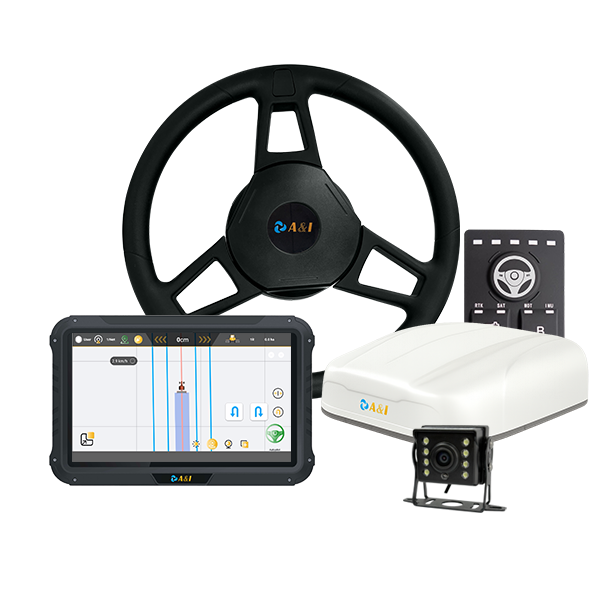
Spraying is a pass-to-pass task: each new run must sit beside the previous one at a controlled distance. A small steering error can create untreated gaps or cause product to be applied twice over part of the field. Tractor GPS for spraying addresses this problem by continuously determining the machine’s position, comparing it with a planned guidance path, and supplying deviation information to the steering system.
Positioning alone, however, does not steer a tractor. Precision comes from a coordinated chain of GNSS positioning, correction data, guidance-line generation, steering control, and implement geometry. When these elements are configured correctly, the machine can follow repeatable routes instead of depending entirely on visual alignment.
The Route Is Calculated Before the Tractor Starts Correcting Itself
Precise guidance begins with a reference path. The operator or field-management system can establish an AB line, curve, or another suitable guidance pattern. Once the route exists, the guidance computer can calculate the tractor’s lateral and directional deviation from the intended track.
That distinction matters during spraying because adjacent passes require consistent spacing. Research describes tractor guidance as a GNSS-based technology that uses positioning and steering to control field paths, while field testing has found automatic steering capable of reducing pass-to-pass overlap and spacing errors during spraying.
Archimedes Innovation’s AS10 follows this type of architecture. Its published product information describes an automatic agricultural driving system based on RTK positioning, an intelligent control terminal, an electric steering wheel, and a high-precision positioning module. It supports AB lines and curved routes alongside other agricultural operating modes.
RTK Gives the Route a Precise Position Reference
A guidance line is only useful if the tractor can determine its position accurately enough to remain close to it. Standard GNSS positioning can operate at meter-level accuracy, which may be insufficient when spraying equipment must maintain narrow and repeatable pass spacing.
RTK improves the positioning reference by using correction information to achieve much finer relative positioning. AS10’s published specifications list RTK horizontal positioning accuracy of ±8 mm + 1 ppm, with a system‑level operational guidance accuracy up to ±2.5 cm for agricultural operations. These are stated product specifications, not a guarantee for every field condition.
Correction quality, satellite visibility, multipath, antenna installation, and local operating conditions still influence positioning performance. The practical engineering question is therefore whether the complete GNSS and correction setup can maintain the repeatability demanded by the spraying pattern.
The Steering Controller Turns Position Error Into a Driving Correction
Once the system knows the tractor’s current position and its relationship to the guidance line, the control layer can determine how steering should change. A tractor autosteer system closes this loop by translating navigation information into steering action instead of leaving the operator to make every correction manually.
The controller continuously evaluates whether the machine is drifting from the desired path and adjusts steering accordingly. The objective is not simply to produce a straight line; it is to maintain the required path geometry throughout the spraying pass.
Yanmar distinguishes GNSS guidance from automatic steering in a similar way. A guidance system displays the tractor’s position and recommended route for manual steering, while an automatic steering system combines GNSS positioning, a motorized steering mechanism, and a monitor to automate steering control.
Boom Width Makes Pass-to-Pass Accuracy Especially Important
Spraying precision is ultimately determined at the implement, not only at the tractor’s GNSS antenna. A tractor may follow its guidance line accurately while the boom experiences positional differences caused by turning dynamics, terrain, or the physical relationship between tractor and sprayer.
Consequently, route guidance must be considered together with working width and pass spacing. If successive passes are too close, spray overlap increases. If they are too far apart, untreated strips can remain between passes.
John Deere notes that implement guidance can improve tool positioning relative to the intended guidance track, including on curves and rolling ground. Its Section Control technology can also switch boom sections on or off when passing previously treated areas or field boundaries. These functions solve related but distinct problems: guidance manages vehicle movement, while section control manages application coverage.
Repeatable Routes Matter More Than One Accurate Pass
A single accurate pass does not demonstrate the full value of precision guidance. Spraying typically involves repeated movement through the same field, so the system must reproduce spacing consistently from one pass to the next.
A study of GNSS-based automatic steering during spraying found lower overlap and spacing errors when automatic steering with RTK correction was used across tillage, sowing, and spraying operations. The researchers also noted that equipment settings and operating conditions influence the resulting benefit.
Archimedes Innovation positions AS10 for crop-protection spraying as well as other agricultural operations. Its published specifications describe an operating speed range of 0.15–25 km/h and support for GPS, BeiDou, GLONASS, and Galileo, providing a multi-constellation positioning foundation for automated guidance.
The Complete Guidance Chain Determines Spraying Precision
A tractor GPS for spraying is therefore not simply a navigation display. Its effectiveness depends on how accurately the positioning module establishes machine location, how reliably correction data is received, how guidance software calculates the desired route, and how quickly the steering controller responds to deviations.
For agricultural equipment integrators, setup should account for antenna position, vehicle dimensions, implement width, steering parameters, guidance-line configuration, correction source, and field conditions. Poor calibration can undermine an otherwise capable positioning system.
Archimedes Innovation‘s AS10 illustrates this integrated approach by combining positioning, control hardware, and route-guidance functions within an agricultural autopilot system. For spraying, the principle is straightforward: GNSS establishes where the tractor is, RTK refines that position, guidance software defines where it should travel, and the tractor autosteer system continuously works to keep the machine on that route.
That combination makes spraying routes repeatable. Instead of asking the operator to estimate spacing visually on every pass, the system maintains a measurable relationship between the tractor, the guidance line, and previous coverage, helping the spraying operation stay aligned with the intended field pattern.
