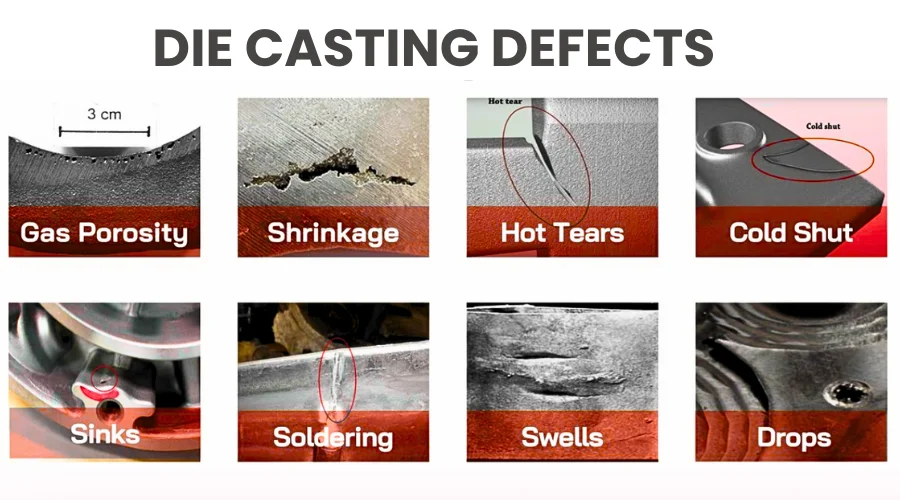
When scaling production for high-volume metal components, unexpected structural flaws can severely jeopardize project timelines and structural performance. Identifying the underlying triggers of manufacturing anomalies is critical for engineers seeking reliable, defect-free parts. This guide breaks down the core mechanisms behind common casting irregularities and outlines actionable engineering strategies to eliminate them.
Understanding the Root Causes of Porosity and Voids
Internal structural integrity remains a primary concern when evaluating complex metal components for heavy-duty engineering applications. Gas porosity typically forms when air, moisture, or vaporized mold lubricants become entrapped by turbulent molten streams during high-speed injection cycles.
Conversely, shrinkage porosity develops during the final solidification phase as the molten alloy contracts internally without adequate feed metal to compensate for volume loss. Thick-walled geometric transitions are exceptionally vulnerable to these volumetric deficits because they retain heat longer than thin sections.
Alloy composition and melt cleanliness also have a direct influence on the formation of aluminium casting defects during high-pressure production. Improper alloy selection, excessive oxide content, or inadequate melt treatment can reduce fluidity and increase internal discontinuities. Applying consistent degassing, filtration, and temperature control helps maintain stable metallurgical properties throughout each production cycle. These measures provide a more reliable foundation for achieving consistent casting strength and dimensional accuracy.
Mitigating these internal anomalies requires deploying vacuum-assisted evacuation systems alongside carefully modeled runner geometries that maintain steady liquid pressure. Engineers frequently encounter aluminium casting defects when metal flow paths create pockets of trapped air that cannot escape before solidification locks the structure.
Efficient air evacuation is particularly important when manufacturing thin-walled or highly complex aluminium components. Insufficient venting can leave residual air trapped inside the cavity, contributing to gas porosity, incomplete filling, and localized surface imperfections. Vacuum systems, optimized vent locations, and properly maintained sealing surfaces can improve cavity evacuation before metal reaches critical areas. Regular inspection of vents and vacuum equipment also helps prevent gradual process deterioration during extended production runs.
Mitigating Surface Blemishes and Filling Failures
Visual surface flaws not only degrade product aesthetics but often signal underlying fluid dynamic failures inside the precision steel die cavity. Flow marks, cold lines, and complete misruns occur when molten metal loses thermal energy prematurely and solidifies before completely fusing.
Low pouring temperatures, restricted gate dimensions, or excessively slow injection velocities heavily contribute to these linear blemishes and incomplete structural fills. Correcting these surface issues requires raising baseline alloy temperatures and maintaining strict thermal equilibrium across the dies prior to injection.
Maintaining a stable die temperature is essential for controlling solidification behavior and minimizing recurring casting problems. Uneven thermal distribution can create localized hot spots, premature freezing, and inconsistent filling across complex cavity sections. Engineers can optimize cooling channels and cycle times to establish a more uniform thermal balance throughout the tooling system. Effective temperature management can significantly reduce surface defects while improving overall production consistency.
When complex thin-walled profiles present persistent resistance, layout adjustments through flow simulations help streamline the metal path and eliminate premature cooling zones. Technical teams must balance injection speed with proper venting to ensure the cavity fills uniformly without trapping residual gases against the tool walls.
Injection pressure and velocity must be carefully coordinated to achieve complete cavity filling without creating excessive turbulence. Excessively high speeds may entrain air and intensify gas-related aluminium casting defects, while insufficient velocity can cause cold shuts or misruns. Using staged injection profiles allows manufacturers to control the transition from slow filling to high-speed cavity completion more effectively. Data-driven parameter optimization can further improve repeatability across large production volumes.
Preventing Flash, Soldering, and Dimensional Warping
Post-pour dimensional deviations frequently stem from mechanical imbalances, excessive injection forces, or improper thermal parameters at the parting line interface. Flash and burrs occur when high-pressure injection forces excess liquid metal through worn parting lines or gaps between poorly clamped mold halves.
On the opposite spectrum, soldering or severe sticking happens when local die temperatures spike or release agents fail, causing aluminum to chemically weld to the tool surface. Regular equipment inspection, proper clamping tonnage, and calibrated lubricant applications are non-negotiable practices for maintaining tight dimensional tolerances.
Unchecked thermal shock can also introduce warping across long linear spans, rendering assemblies misaligned during subsequent secondary machining operations. Addressing aluminium casting defects of this mechanical nature demands rigorous monitoring of machine toggle pressures and cycle timing adjustments.
Implementing Process Optimization and Tool Maintenance
Long-term production success relies heavily on proactive engineering protocols, systematic data logging, and strict preventive maintenance schedules for all active tooling assets. Monitoring real-time injection parameters allows technicians to detect subtle pressure drops or velocity spikes that precede major structural flaws.
Casting simulation provides engineers with an opportunity to identify potential filling, solidification, and thermal problems before physical tooling is finalized. Flow analysis can reveal areas where turbulence, air entrapment, premature cooling, or shrinkage risks are likely to occur. By adjusting gates, runners, overflow locations, and cooling layouts during the design stage, manufacturers can reduce costly trial-and-error modifications. This proactive approach is especially valuable when controlling aluminium casting defects in high-volume manufacturing programs.
Consistent quality requires more than correcting defects after they appear; manufacturers should continuously track critical process variables throughout production. Parameters such as metal temperature, die temperature, injection velocity, pressure curves, cycle time, and vacuum performance can provide valuable process signals. Combining these measurements with dimensional inspection and internal quality testing helps identify recurring defect patterns at an early stage. A structured quality monitoring system enables faster corrective action and supports stable, repeatable aluminium casting production.
Collaborating with specialized manufacturers ensures that potential defect vectors are intercepted before they compromise your final product assembly or inflate scrap rates. HordRT implements rigorous quality controls and advanced simulation tools to safeguard project timelines and budget integrity across every batch.
By refining gating designs, thermal channels, and alloy pouring parameters, HordRT helps engineering teams eliminate persistent aluminium casting defects entirely. Prioritizing these foundational manufacturing adjustments guarantees consistent mechanical performance, superior surface finishes, and dependable structural longevity for demanding applications.
