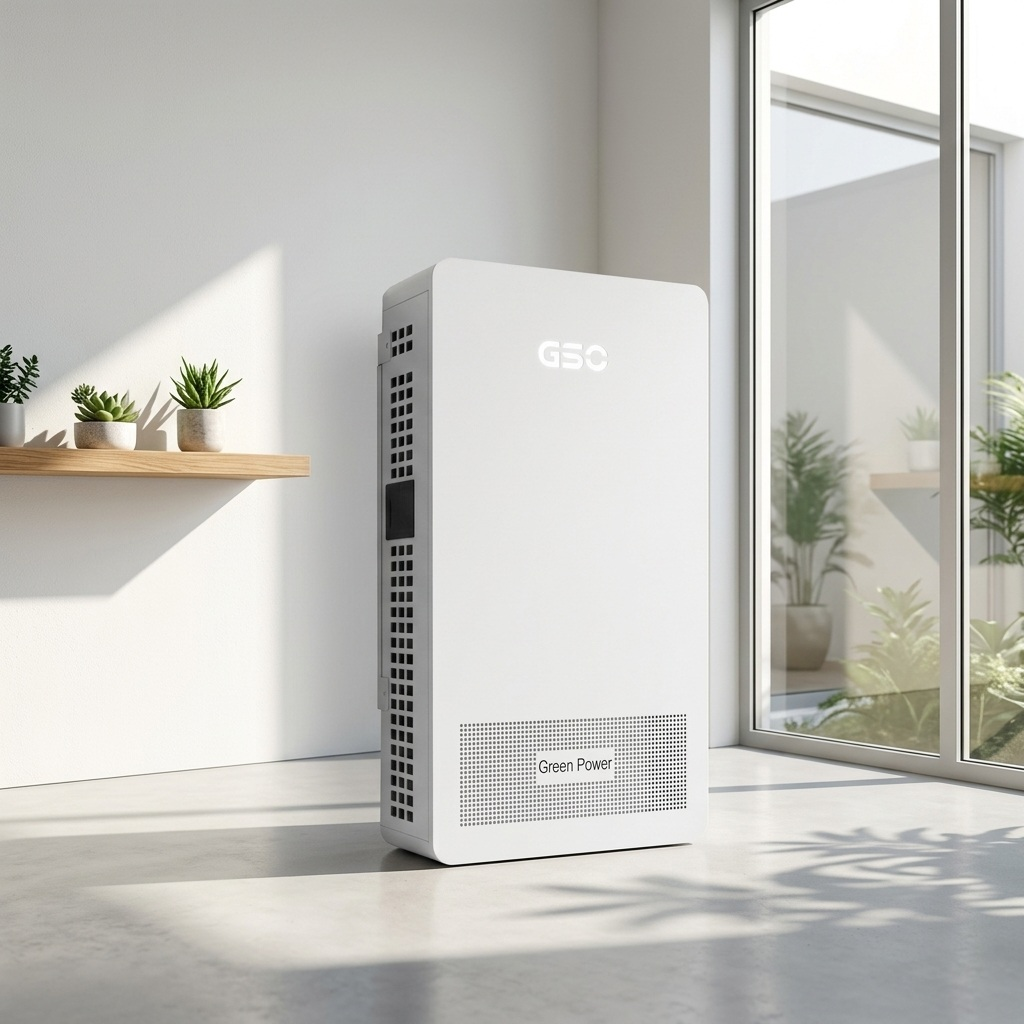
Photovoltaic panels can produce electricity only while sufficient solar energy is available, yet the demand for power continues after sunlight weakens or disappears. A solar system battery bank provides the storage stage that separates the time of generation from the time of use.
Instead of allowing every surplus unit of solar electricity to be consumed immediately or left unused, the battery bank stores part of that energy and releases it when demand exceeds current solar production. Within a solar battery storage system, the battery therefore works together with the PV array, hybrid inverter, charging controls, and household or commercial loads as one coordinated energy path.
Following the Energy From Panels to Loads
The simplest way to understand a battery bank is to follow the direction of power through the system. Solar electricity first reaches the inverter through its photovoltaic input. The MPPT function tracks the operating point of the solar array so available PV power can be used efficiently. Active loads are normally supplied first, while surplus generation can be sent to the battery.
A solar system battery bank becomes active in the opposite direction when solar production falls. Stored DC energy moves back through the inverter, which supplies the AC loads connected to the installation. The same stored energy can also be used during a grid outage or at times when electricity prices make battery discharge preferable.
Charging priorities can vary. Configurations may use solar-only charging, solar-first operation, grid-first charging, or a hybrid strategy. These modes change where the battery receives energy and when stored electricity is preserved for later use.
Those settings also change the timing of reserve formation: solar-only charging depends entirely on available PV production, while grid-first or hybrid operation can replenish the bank from another source, so the selected priority affects how much stored energy is available before evening demand or an outage for backup planning.
Capacity Begins With the Load Profile
Battery sizing is fundamentally an energy calculation rather than a guess based on physical battery size. Daily electricity consumption establishes how much energy the property normally uses, while desired autonomy determines how long storage should support those loads without sufficient solar production or grid power.
Nominal energy is calculated from battery voltage and amp-hour capacity. For a 48 V bank rated at 100 Ah, the nominal stored energy is 4,800 Wh (4.8 kWh), obtained by multiplying the two ratings. In a solar battery storage system, that figure must then be considered together with usable capacity, depth of discharge, expected losses, and the actual loads that will remain connected during backup operation.
Longer autonomy does not always require a completely different system. Parallel or stacked battery modules can increase total capacity where the platform supports expansion. This modular approach makes it possible for storage to grow with household or business demand instead of forcing every project to begin at its maximum future size.
Control and Compatibility Shape Battery Performance
A battery bank must operate within the voltage, current, and communication limits of the inverter. That relationship is especially important in lithium-based systems where the BMS supervises battery status and protection.
The referenced home-storage batteries use LiFePO4 cells; their stated endurance exceeds 6,000 cycles at 80% DoD, with a 10-year design life. Within a solar system battery bank, those figures describe expected cycling capability, but they do not replace system matching.
Maximum charge and discharge current, inverter protocol compatibility, temperature, ventilation, and installation location still influence the final design. Together, these limits define whether the battery bank remains compatible with the surrounding power electronics and installation conditions.
Battery monitoring also becomes part of routine operation. GSOpower storage systems can present battery state, power flow, and fault information through an inverter APP or cloud platform. Compatible integrated systems list grid-to-battery switching times as low as 10 ms, linking storage capacity with the control response needed during a change in power source.
Physical Format and Future Expansion
Storage equipment can serve the same electrical function while taking very different physical forms. Wall-mounted batteries conserve floor space, wheeled units can simplify placement changes, and stackable modules can support compact expansion. Each format affects installation planning even when the underlying purpose remains the same.
A solar battery storage system should consequently be designed around both present and future constraints. Available space, expected energy growth, battery cooling, ambient temperature, cable routing, and service access all influence whether additional modules can be added later.
GSOpower’s residential range includes wall-mounted, wheeled, and stackable options, illustrating how a common storage role can be adapted to different installation layouts. The appropriate format depends on site conditions rather than on appearance alone.
A battery bank is best understood as the part of a solar installation that gives generated electricity a second time of use. It receives surplus energy, stores it under controlled conditions, and returns it to the load when solar production, grid availability, or electricity pricing makes discharge useful.
A properly sized solar system battery bank therefore depends on energy consumption, autonomy, battery voltage, charge and discharge limits, inverter compatibility, BMS protection, installation environment, and expansion requirements. When those elements are coordinated, the solar battery storage system becomes a functional energy-management system rather than simply a collection of battery modules.
