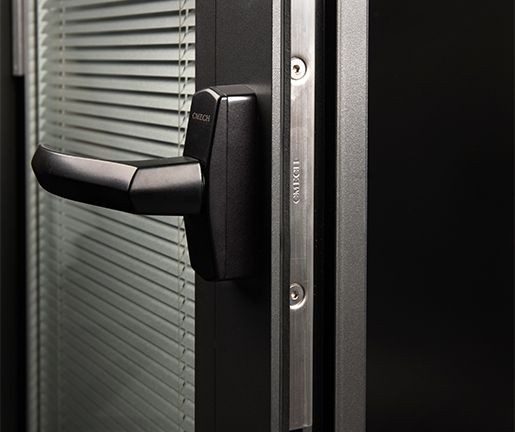
Window latches help keep windows securely closed, support smooth daily operation, and contribute to the overall security of residential and commercial buildings. However, different window styles require different locking mechanisms, and the effectiveness of a lock depends on more than the latch itself. Understanding common latch types, security testing, and signs of wear helps property owners, contractors, and renovation professionals make informed decisions. CMECH provides door and window hardware for various architectural applications, making product compatibility, installation requirements, and functional performance important considerations when selecting replacement components.
Common Types of Window Latch Hardware
The appropriate window latch depends on the window’s opening mechanism, frame construction, and intended application. Identifying these factors helps prevent compatibility problems during installation.
Cam locks and crescent latches are commonly used on sliding windows. A cam lock rotates to engage a keeper on the frame, while a crescent latch uses a curved component to secure the sash. Both designs require suitable mounting dimensions and properly aligned engagement points.
Sweep locks use a lever or locking arm to secure certain sliding windows. When selecting replacement window latch hardware, buyers should check the mounting-hole spacing, locking direction, and available clearance to ensure the mechanism fits the existing assembly.
Casement window locks are designed for windows that open on hinges. Some use locking handles connected to internal mechanisms, while others incorporate multiple locking points around the sash. Multipoint mechanisms can distribute engagement across several locations, although their actual security performance depends on the complete assembly and installation.
Keyed locks and window restrictors serve different purposes. Keyed locks can control access, whereas restrictors limit how far a window opens. A restrictor should not automatically be considered equivalent to a locking mechanism designed to resist forced entry.
Understanding these differences helps buyers identify suitable window latch hardware rather than choosing a component based only on its appearance.
Understanding Window Security Ratings
Security ratings can be confusing because a standalone latch and a complete window assembly are not necessarily evaluated in the same way. There is no single universal security rating that applies to every window lock.
In the United States, ASTM International publishes standards for evaluating window performance. ASTM F588-26 addresses forced-entry resistance of window assemblies, while ASTM E2395-21(2025) covers security performance requirements and testing for window and door assemblies that include glazing-impact evaluation. These standards assess defined aspects of assembly performance rather than assigning one universal grade to every latch.
When evaluating window latch hardware, buyers should ask whether the complete window assembly has been tested to a recognized standard, which configuration was evaluated, and whether the proposed locking components match that configuration. Relevant test documentation is more meaningful than broad claims such as “high security.”
A strong latch cannot compensate for a weak frame, unsuitable glazing, poorly secured fasteners, or incorrect installation. Similarly, replacing a component with an incompatible model may affect the performance of a previously tested assembly. Projects with specific security requirements should identify the applicable standard and required performance level before hardware is selected.
Signs That Window Latch Hardware Needs Replacing
Regular inspection helps identify problems before a locking mechanism becomes unreliable. Not every operating issue requires a new latch, so the underlying cause should be assessed first.
Difficulty locking or unlocking may indicate worn components, a misaligned keeper, or a sash that has shifted. Check the window’s alignment and mounting points before assuming the latch itself has failed.
Corrosion and physical damage are additional warning signs. Rust, cracked handles, bent locking arms, and damaged mounting points can interfere with proper engagement. Windows exposed to coastal air or persistent moisture may require more frequent inspection, depending on the materials and environmental conditions.
Loose fittings or incomplete engagement should also be addressed promptly. If a sash does not remain securely closed when locked, inspect the latch, keeper, fasteners, and surrounding frame. A damaged mechanism should not be relied upon until it has been repaired or replaced.
Replacement may also be necessary during renovations, when a window’s operating mechanism changes, or when compatible spare parts are unavailable. The replacement should match the window’s dimensions, frame material, opening method, and performance requirements.
How to Select Compatible Window Hardware
Choosing replacement components involves more than matching the finish. Buyers should record the window type, sash dimensions, latch position, mounting-hole spacing, and keeper design. They should also determine whether the existing system uses a single locking point or an interconnected mechanism.
Material selection matters because hardware must suit the expected environmental conditions and frame construction. Components designed for one window profile may not fit another, even when the windows look similar. Incompatible fasteners or unsuitable modifications can also affect installation quality and performance.
For larger construction and renovation projects, documenting requirements by window type can help prevent mismatched components and simplify future maintenance. When a window forms part of a tested security assembly, replacement decisions should account for the original system specifications.
CMECH offers hardware for door and window applications. When reviewing window hardware, project teams should consider how locking mechanisms, handles, frames, and installation requirements work together. The appropriate selection depends on the intended application and the technical information available for the relevant configuration.
CMECH and Window Hardware Solutions
CMECH focuses on door and window hardware systems for different architectural applications. Its product offering is relevant to projects where operating components need to function together within a complete assembly.
For architects, fabricators, contractors, and property owners, a systems-based approach helps keep product selection aligned with window design and installation requirements. Before specifying a particular component, buyers should confirm its compatibility, operating method, and applicable performance documentation.
Buyers can review CMECH’s window hardware range to identify components compatible with their window configuration and project requirements. As with any hardware selection, the final decision should reflect the actual window configuration, project requirements, and available technical evidence.
Conclusion
Selecting window latch hardware requires attention to compatibility, usability, maintenance, and security expectations. Understanding the differences between sliding-window latches, casement locks, keyed mechanisms, and restrictors helps buyers identify suitable options. Security claims should be evaluated against relevant testing documentation, while corrosion, physical damage, and unreliable engagement indicate when inspection or replacement may be needed. By considering the complete window assembly and its operating requirements, buyers can make informed decisions when evaluating products from manufacturers such as CMECH.
