A sunlit master cabin can remain uncomfortably warm while an interior guest room on the same Yacht feels cool. Their occupants may also keep different schedules, leaving one space empty during the day and another occupied through the night.
Treating the vessel as a single thermal zone conceals these differences. The Yacht’s total cooling capacity cannot explain how well separate rooms will perform when their exposure and occupancy differ.
Map the Cooling Demand Cabin by Cabin
A Yacht AC layout begins with the rooms people actually use. Glazing, insulation, deck exposure, cabin volume and the number of occupants change the heat entering each space. A shaded forward berth rarely behaves exactly like a saloon with broad windows. Cooling requirements can also shift as the Yacht changes heading, mooring position or operating region.
Separate loads do not automatically require every cabin to have an identical machine. A smaller room may need less capacity, while a heavily glazed compartment needs closer examination during sunny hours. Distribution matters as much as the BTU rating: cool supply air must reach the intended area, and a clear return path is necessary for the unit to sense and respond to cabin conditions.
Give Each Zone a Physical Air and Water Route
Independent cooling equipment still has to fit real joinery. A blower discharge that faces a bulkhead can complicate duct installation, and a service hatch hidden beneath fixed furniture may make future inspection unnecessarily difficult.
On a multi-cabin Yacht, routing must also account for seawater intake, discharge and each unit’s required flow. These circuits need deliberate engineering even where the refrigeration components are integrated.
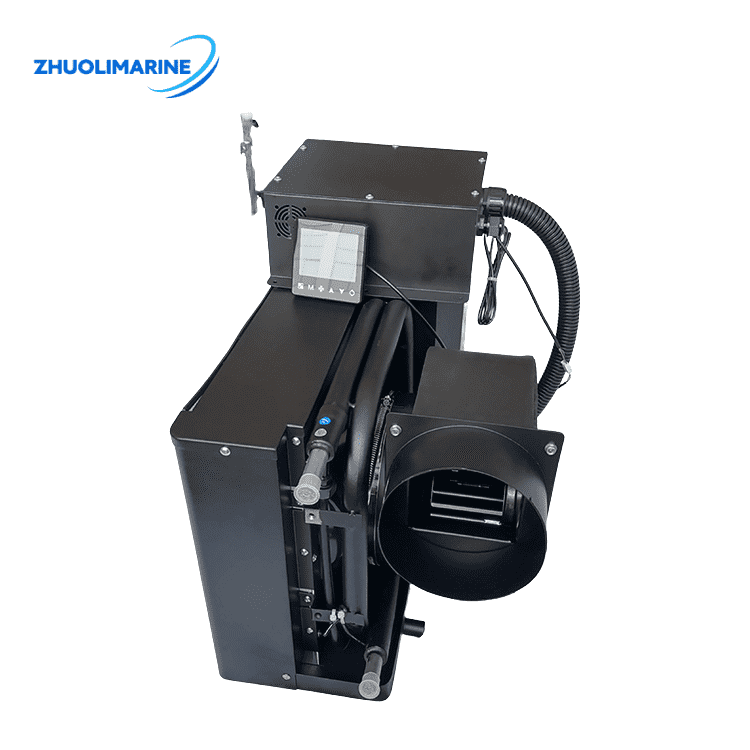
The MAR-12V/12BP is a 12V Yacht unit rated at 12,000 BTU cooling and 12,250 BTU heating, with 550 m³/h airflow and 1,080 L/h seawater flow. Its 480 × 330 × 335 mm housing and adjustable 360-degree blower are pertinent to constrained installations.
In ZhuoliMarine’s range, those figures describe one dedicated 12V DC system; they do not imply that a single unit will cool several disconnected cabins through walls or closed doors.
Match Voltage to the Existing Distribution System
The relevant supply may be a 12V battery bank, a higher-voltage DC circuit or AC power supported by shore connection or a generator. Selecting a compatible input is an electrical-design task, not a matter of assuming that equipment of similar cooling capacity is interchangeable. High DC current influences cable size and protection, whereas an AC-fed installation introduces its own distribution and supply requirements.
For Yacht AC planning, the MAR-12V/12BP lists 840 W rated input, 70 A rated current and 900 W maximum. A different model, MAR-220/16BP, provides 16,000 BTU cooling on single-phase 220V AC at 60 Hz; its figures are 1,130 W rated input, 5.2 A rated current and 1,280 W maximum.
The MAR-48V/16BP instead uses 48V DC, also offering 16,000 BTU cooling with 1,130 W rated input and 23.5 A rated current. The electrical sources must be matched to the actual model.
Distinguish Independent Cooling from Shared Control
Multi-cabin operation raises two separate questions: how each cabin is cooled and how the occupants adjust their settings. A phone controlling more than one installed unit does not turn those units into a single ducted refrigeration system.
Each independently served space still requires its own appropriate equipment, air circulation and heat-rejection arrangements. Service access must remain possible even after additional cabinetry is installed.
The MAR-220/16BP supports control of multiple units from one mobile device, a feature offered within ZhuoliMarine‘s broader marine range. That capability can simplify adjustment across separately equipped rooms, but it does not establish universal compatibility between different voltages or models.
The 12V Yacht model includes built-in Wi-Fi control and a replaceable air filter, but it requires a 12V DC supply rather than a switchable AC/DC connection. An empty guest cabin need not follow the same thermostat schedule as an occupied master berth, provided each independently served space has a suitable control and cooling arrangement.
Test the Whole Arrangement Before Final Placement
A useful installation review follows electricity, air and water from their sources to their destinations. Cabinet dimensions, expected seawater flow, available current and access for maintenance should be assessed for each zone. The 16,000 BTU AC and 48V DC examples both specify 650 m³/h airflow and 1,250 L/h water flow, indicating why routing deserves the same attention as electrical compatibility.
A successful Yacht AC design therefore combines local comfort requirements with the realities of onboard distribution. Operating modes, changing occupancy and independent room temperatures can be accommodated only within the capabilities of the selected system. On a multi-cabin layout, the total current and seawater demand during simultaneous operation may be more restrictive than any one unit’s cabinet dimensions.
Separate cabin ratings only become a Yacht-wide design when simultaneous loads and shared power and seawater routes have been accounted for. Installation materials and remote technical assistance accompany the DC and AC self-contained cooling and heating options in ZhuoliMarine’s marine range.
The cabin schedule must also identify equipment that remains accessible after joinery is finished. The electrical and plumbing installers can use that schedule to reconcile the combined demand.
